
All posts by IT Admin
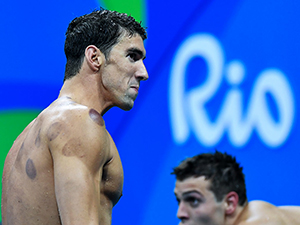
Cupping and the Rio Olympics 2016
Cupping therapy is a form of alternative medicine in which cups are placed on the skin to create suction. The cups can be made of a variety of materials, including:
Glass
Bamboo
Earthenware
Supporters of cupping therapy believe the suction of the cups mobilizes blood flow to promote the healing of a broad range of medical ailments.
Cupping therapy dates back to ancient Egyptian, Chinese, and Middle Eastern cultures.
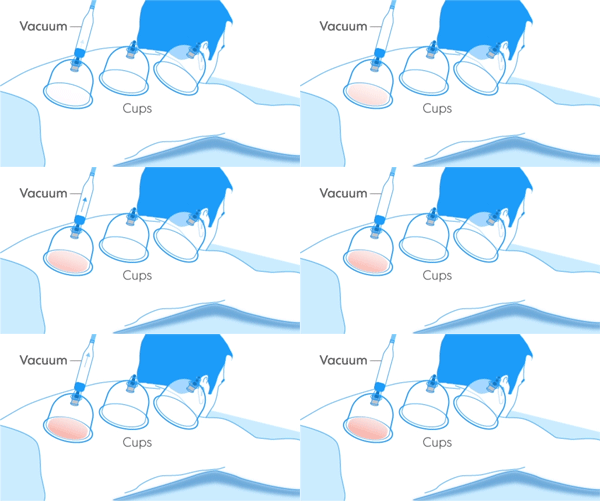
HOW CUPPING WORKS
Types of Cupping Therapy
There are various types of cupping therapy, including:
- Dry cupping (suction only)
- Wet cupping (combination of suction and controlled medicinal bleeding)
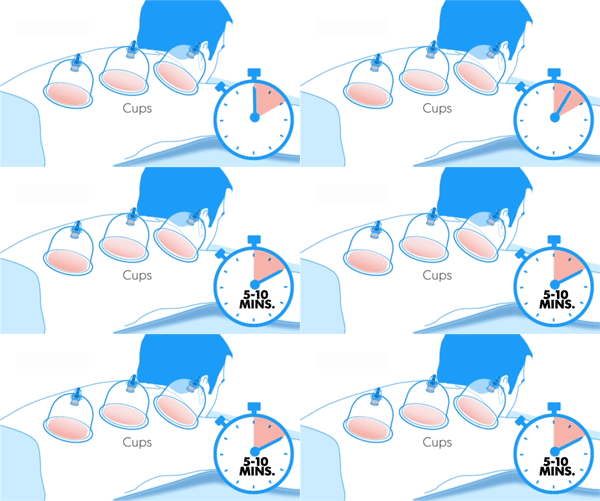
During both types of cupping, a flammable substance such as alcohol, herbs, or paper is placed in a cup and set on fire. As the fire goes out, the cup is placed upside down on the patient’s skin. As the air inside the cup cools, it creates a vacuum. This causes the skin to rise and redden as blood vessels expand. The cup is generally left in place for five to 10 minutes.
A more modern version of cupping uses a rubber pump to create the vacuum inside the cup. Sometimes practitioners use medical-grade silicone cups. These are pliable enough to be moved from place to place on the skin and produce a massage-like effect.
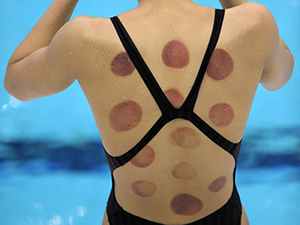
During wet cupping, a mild suction is created using a cup that is left in place for about three minutes. The practitioner then removes the cup and uses a small scalpel to make superficial skin incisions. Then he or she performs a second suction to draw out a small quantity of blood.
After the procedure, the site may be covered with an antibiotic ointment and bandage to prevent infection. The skin’s appearance generally returns to normal within 10 days.
Cupping therapy supporters believe that wet cupping removes harmful substances and toxins from the body to promote healing.
Benefits of Cupping Therapy
Cupping therapy can used to treat:
- Blood disorders such as anemia and hemophilia
- Rheumatic diseases such as arthritis and fibromyalgia
- Fertility and gynecological disorders
- Skin problems such as eczema and acne
- High blood pressure (hypertension)
- Migraine
- Anxiety and depression
- Bronchial congestion caused by allergies and asthma
- Varicose veins
Side Effects of Cupping Therapy
Cupping is considered to be relatively safe, especially when performed by trained health professionals. Potential side effects include:
- Mild discomfort
- Burns
- Bruises
- Skin infection
What does the evidence say?
In previous studies, cupping has been used for treating cancer pain and lower back pain. In both of the randomized clinical trials, groups that received the cupping therapy reported more favorable effects in pain relief.
But this is just two trials with small sample sizes, so the researchers wrote in 2011 that it’s hard to “draw firm conclusions” based on limited data, in a review published in Evidence-Based Complementary and Alternative Medicine.
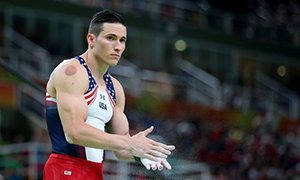
Most published studies, however, focus on wet cupping, which is a form of medicinal bleeding. In this process, the skin is cut and the blood is pooled into the suction cup. Based on social media photos, the athletes have opted for the non-bleeding therapy, which is known as dry cupping.
So far, the repeated effect of cupping therapy over time is not known, but it’s generally believed to be safe, according to research published in 2012.
Take this Test NOW: Sitting – Rising Test.
No time for exercise? Too busy to eat right? What kind of a toll is it all taking on your health?
There’s a simple test you can do just about anywhere that’s been proven to predict how long you’ll live. A doctor in Brazil invented the Sitting and Rising Test or SRT, and he’s proven it can predict your risk of dying in the next five years
Sit. Stand. Repeat.
This little trick — a deceptively simple measure of flexibility and strength — can predict who will live longer and whose lives will be cut short. A Brazilian physician uses the test with athletes, but he also uses it to lay out the stakes with patients: To live longer, they must get moving and maintain muscle and balance.
Many patients, particularly older people, have trouble with ordinary motions such as bending down to pick up something off the floor — difficulty indicative of a loss of flexibility. As people age, reduced muscle power and loss of balance can greatly increase the risk of dangerous falls.
Patients would benefit from learning about the importance of staying fit and have concrete information about where they have room to improve. While there are many existing clinical tests assessing flexibility, balance and muscle strength, most are too impractical or time-consuming.
So Dr. Araujo and his colleagues developed an alternative, which they call the sitting-rising test, or SRT. It requires no equipment or walking paths — just a clear patch of floor and a willing participant.
Try It
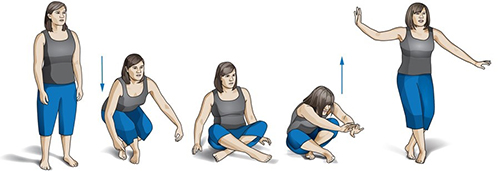
- Stand in comfortable clothes in your bare feet, with clear space around you.
- Without leaning on anything, lower yourself to a sitting position on the floor.
- Now stand back up, trying not to use your hands, knees, forearms or sides of your legs.
Scoring
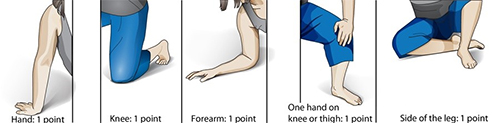
The two basic movements in the sitting-rising test — lowering to the floor and standing back up — are each scored on a 1-to-5 scale, with one point subtracted each time a hand or knee is used for support and 0.5 points subtracted for loss of balance; this yields a single 10-point scale.
According to the study,
- people who scored fewer than eight points on the test, were twice as likely to die within the next six years compared with those who scored higher
- those who scored three or fewer points were more than five times as likely to die within the same period compared with those who scored more than eight points.
Overall, each point increase in the SRT score was associated with a 21 percent decrease in mortality from all causes.
Some Pain is Good Pain.
Difference Between Good and Bad Pain
Some discomfort is part of athletic activities and is often part of a successful training program. For muscle strength to increase, muscles must experience an increase in stress and this stress is usually perceived as the “burn” in muscle during activity.
This mild burn is what we call good pain and is the basis of the popular phrase, “No pain, no gain.”
This pain should be short-lived and resolve soon after the activity ends.
‘Good Pain’ Versus ‘Bad Pain’
Fatigue after a good, strenuous workout is a sign that the exercise is pushing the limits of the athlete’s fitness…
but it too should not be excessive. This fatigue should leave you somewhat exhilarated but not overly exhausted.
Chronic fatigue after excessive exercise suggests that the individual may be over training. If after appropriate rest the fatigue continues, it may be a sign of other medical problems and you should consult a doctor.
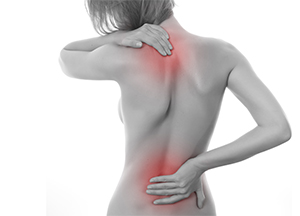
What are the signs of bad pain?
The muscles, tendons, ligaments, cartilage and bones of the body are living structures that react to the stress of exercise only gradually. If they see stress too fast, they cannot respond effectively and may begin to fail. When this occurs, each one of these tissues responds a little differently and this can result in bad pain.
Muscles:
- Muscle soreness typically occurs if you do a new exercise to which you are not accustomed or if you do a familiar exercise too hard.
- This soreness typically begins within a few hours but peaks one to two days after exercise.
- This soreness is called delayed onset muscle soreness.
- A little soreness or discomfort means that the muscle has been stressed, but if the muscle is exercised too much, the muscle can become very sore to move and touch and may even swell.
- To prevent this problem with your muscles, we usually recommend the following rule:
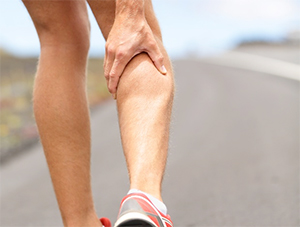
Take the amount of exercise you think you can do and cut it by one third the first few times you do it.
Tendons:
- Tendons that connect muscle to bones may get irritated if they see too much stress too rapidly.
- They respond by getting inflamed, which is characterized by pain and sometimes swelling.
- Tendonitis pain typically occurs during exercise and can continue afterward when performing activities using that muscle or tendon.
- In more severe cases the tendon may become swollen and any movement of the tendon or knee joint can hurt.
Bones:
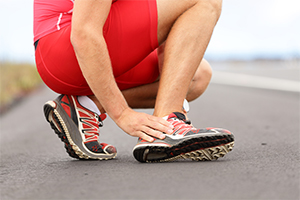
- Bones need time to respond to new stress.
- When bones see increased amount of stress, such as an increase in running when preparing for a marathon, they respond by putting more bone in the areas of the bone that are seeing more stress.
- The first sign of this stress reaction is pain along the bone, which occurs with activity. As the situation worsens, a stress fracture can develop.
Cartilage:
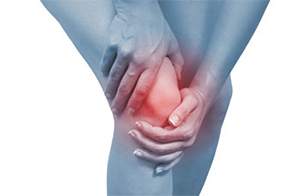
- Cartilage also needs stress applied very gradually.
- Cartilage is the slippery white tissue on the ends of the bones in the joint that allows the bones to glide and move smoothly over one another.
- When the cartilage sees too much stress too rapidly, it can result in pain and fluid in the joint. Swelling in a joint is a worrisome sign meaning that the cartilage is irritated.
How can this pain be treated?
The treatment for any ache or pain after exercise is to cut back on the exercise for a period of time. How long to rest the area depends upon the severity of the pain. Typically we tell patients not to do anything that hurts. It is important to maintain aerobic capacity or stamina when resting a body part, so other exercises that do not cause pain are usually acceptable.
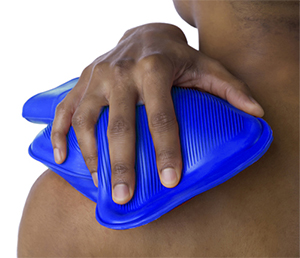
The second way to treat a painful area is by icing. Ice should be used after activity with an ice pack or ice massage for 20 minutes. The old standard of ice for 48 hours followed by heat is no longer recommended. We believe that ice is your friend. However, if pain persists despite the use of ice, more serious problems may exist and you should consult your physician.
The third thing to do if you have aches and pains after exercise is to continue to move the joint or extremity to avoid stiffness. If the joint becomes stiff over time it will affect the ability of the joint to function normally and may affect athletic performance as well. Range of motion exercises or stretching to maintain the motion of the joint should not be confused with exercising the joint, which tends to stress the structures and make the pain worse.
The fourth way to treat aches and pains is with over-the-counter pain relievers or anti-inflammatory agents. These medicines include acetaminophen, ibuprofen, naproxen and aspirin and are believed to be effective at decreasing pain and swelling. If you do not have any contraindications to taking these medications, we suggest following the instructions on the label.
When should I be concerned about bad pain?
There are several things you should look for when judging how concerned to be about your pain.
- First, the pain should not last long after exercise.
- Pain that does not go away with rest is not normal.
- Pain that begins to affect your function outside of sports, such as walking or sleeping, is not normal.
- Pain that is constant or increasing over time and does not go away is not normal.
- Pain that does not improve with treatment may be something to be concerned about.
- Pain that begins to wake you from your sleep is also a concern, especially if it increases over time.
Fevers, chills or severe sweating at night are not normal and you should consider seeking evaluation right away.
If you have any question about whether an injury is serious or not, you should seek treatment.
Exercise as You Age – Happy New Year!.
Exercise as You Age
With 2016 around the corner, an active lifestyle is more important than ever. Regular exercise can help boost energy, maintain your independence, and manage symptoms of illness or pain. Exercise can even reverse some of the symptoms of aging. And not only is exercise good for your body, it’s also good for your mind, mood, and memory.
Happy New Year!!
Myths about exercise and aging
Myth 1: There’s no point to exercising. I’m going to get old anyway.
Facts
- Exercise and strength training helps you look and feel younger and stay active longer.
- Regular physical activity lowers your risk for a variety of conditions, including Alzheimer’s and dementia, heart disease, diabetes, certain cancers, high blood pressure, and obesity.
- And the mood benefits of exercise can be just as great as 70 or 80 as they were at 20 or 30.
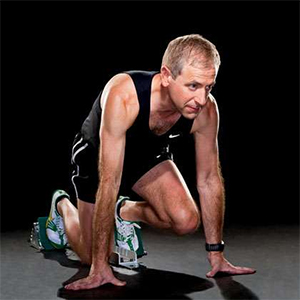
Dan Weiser, 52 – Sprinter
Myth 2: Older people shouldn’t exercise. They should save their strength and rest.
Facts
- Research shows that a sedentary lifestyle is unhealthy for adults over 50.
- Inactivity often causes older adults to lose the ability to do things on their own and can lead to more hospitalizations, doctor visits, and use of medicines for illnesses.
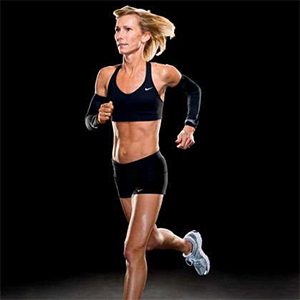
Colleen de Reuck, 46 – Marathon Runner
Myth 3: Exercise puts me at risk of falling down.
Facts
- Regular exercise, by building strength and stamina, prevents loss of bone mass and improves balance, actually reducing your risk of falling.
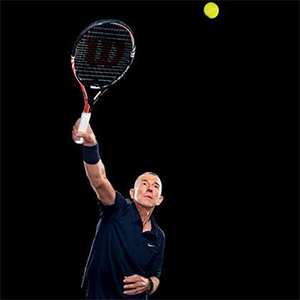
Brian Cheney, 63 – Tennis Champion
Myth 4: I’m disabled. I can’t exercise sitting down.
Facts
- Chair-bound people face special challenges but can lift light weights, stretch, and do chair aerobics, chair yoga, and chair Tai Chi to increase range of motion, improve muscle tone and flexibility, and promote cardiovascular health.
- Many swimming pools offer access to wheelchair users and there are adaptive exercise programs for wheelchair sports such as basketball.
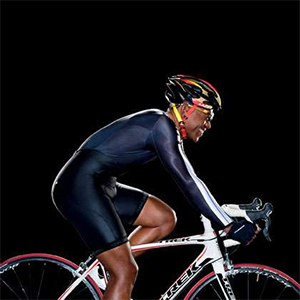
Ron Lacey, 54 – Cyclist
Physical health benefits of exercise and fitness for older adults
- Maintain or lose weight
- Increase metabolism and build muscle mass
- Reduces the impact of illness and chronic disease
- Improved immune function
- Better heart health and blood pressure
- Better bone density
- Enhances mobility, flexibility, and balance in older adults.
- Improves your strength, flexibility and posture
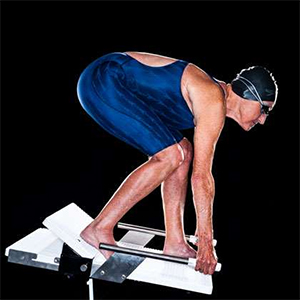
Joan Campbell, 80 – Swimmer
4 Steps to a Healthy 2016!
- Cardio endurance exercise
- Cardio workouts get your heart pumping and you may even feel a little short of breath.
- Cardio includes walking, stair climbing, swimming, hiking, cycling, rowing, tennis, and dancing.
- Promotes independence by improving endurance for daily activities such as walking, house cleaning, and errands.
- Strength and power training
- Strength training builds up muscle with repetitive motion using weight or external resistance
- Strength training helps prevent loss of bone mass, builds muscle, and improves balance
- Flexibility
- Challenge the ability of your body’s joints to move freely through a full range of motion.
- Yoga is an excellent means of improving flexibility.
- Helps your body stay limber and increases your range of movement for ordinary physical activities such as looking behind while driving, tying your shoes, shampooing your hair, and playing with your grandchildren.
- Balance
- Maintain standing and stability, whether you’re stationary or moving around.
- Try yoga, Tai Chi, and posture exercises to gain confidence with balance.
- Also reduces risk of falling and fear of falls.
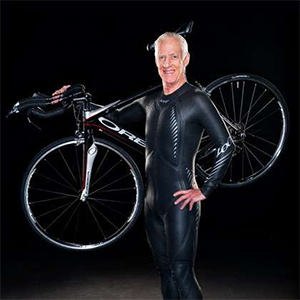
Bob Heins, 71 – Triathlete
a
Tips for a Healthy Thanksgiving.
Tips for a Healthy Thanksgiving
Thanksgiving comes around once a year, so now is the time to splurge, right?
Well….maybe not!
Gaining weight during the holiday season has become a national pastime. Year after year, most of us pack on at least a pound (some gain more) during the holidays — and keep the extra weight permanently.
But Thanksgiving does not have to sabotage your nutrition and fitness goals. With a little knowledge, you can still enjoy a guilt-free Thanksgiving feast.
Eat Breakfast
- You might think it makes sense to save up calories for the big meal, but eating a small meal in the morning can give you more control over your appetite.
- Start your day with a small but satisfying breakfast — so you won’t be starving when you arrive at the gathering.
- “Eating a nutritious meal with protein and fiber before you arrive takes the edge off your appetite.”
Lighten Up
- Whether you are hosting or enjoying a potluck, make your recipes healthier with less fat, sugar, and calories.
- Some suggestions:
- Use fat-free chicken broth to baste the turkey and make gravy.
- Use sugar substitutes in place of sugar and/or fruit purees instead of oil in baked goods.
- Reduce oil and butter wherever you can.
Police Your Portions
- Before you fill your plate, survey the buffet table and decide what you’re going to choose.
- Then select reasonable-sized portions of foods you cannot live without.
- “Don’t waste your calories on foods that you can have all year long.”
- Skip the Seconds.
- Try to resist the temptation to go back for second helpings.
- “Leftovers tend to be much better the next day, and if don’t overeat, you will have more room for a delectable dessert.”
Slowly Savor
- Eat slowly. Put your fork down between bites. Taste each mouthful.
- Whole grains, fruits, vegetables, broth-based soups, salads, and other foods with lots of water and fiber add to the feeling of fullness.
- Spread out the food and fun all day long.
Go Easy on Alcohol
- Don’t forget those alcohol calories that can add up quickly.
- “Have a glass of water or clear soda between alcoholic drinks, this way you stay hydrated, limit alcohol calories, and stay sober.”
Beat the Super Bowl Bulge
Don’t Just Sit and Watch:
Beat the Super Bowl Bulge!
The Super Bowl is like the Thanksgiving Day of football: It’s filled with friends, family, and, of course, lots and lots and lots of food.
On average people consume 1,200 calories during the game (and celebrations around it).
This is a day when sitting in front of the television for hours is totally acceptable, which makes mindless eating difficult to avoid.
The good news is that you don’t have to sit back and let the Super Bowl undo the healthy lifestyle you work so hard to maintain.
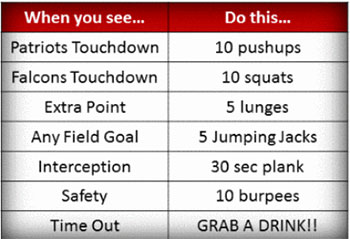
I have We’ve compiled several fitness challenges to play during the Super Bowl — my alternative to drinking games for the active set.

Follow us:


4 Core Exercises That Are Better Than Regular Planks
Everyone knows how much I LOVE planks!
Planks are great, but most people tend to just dangle in them and remain static, which does not optimize the results. Even when performed correctly, static planks only work one section of your core muscles.
Don’t get me wrong, in order to perform the below listed exercises, you MUST master the plank.
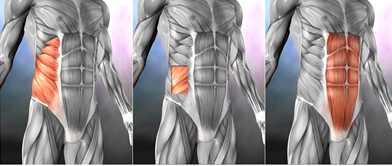
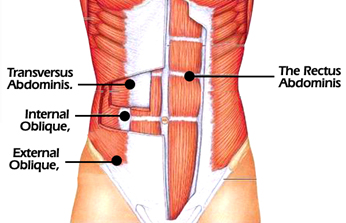
However, to most effectively strengthen your core, you have to work all of your core muscles:
- Rectus Abdominus
- Internal and External Obliques
- Transversus Abdominis
- Glut Muscles
- Lumbar Parapsinals
Here are four exercises better than regular planks:
1.Rowing Machine Rollouts
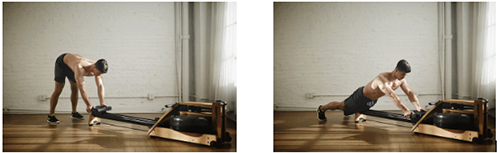
- Stand in front of a rowing machine and bend forward at the waist to place your palms on the seat of the machine.
- From here, inhale through your nose and, keeping your arms relatively relaxed, extend them in front of you so that your body lowers into a plank position.
- Once your body forms a straight line from your head to heels, forcefully exhale and squeeze your core to fold your arms and torso back toward your legs.
2.Single-Arm Plank + Single-Arm Banded Row
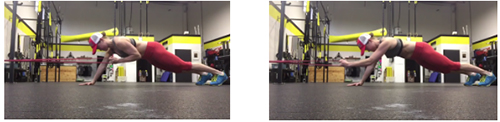
- Get in a plank on the floor, a few feet away from the end of a secured resistance band.
- Your body should form a straight line from head to heels.
- With your feet spread hip-width apart and your hands spread shoulder-width apart and just in front of your face, brace your core and squeeze your glutes.
- Grab the end of the resistance band with one hand and, keeping your body and torso stable, row the band toward your chest.
- Perform all reps, then switch sides.
3. Stability Ball Knee Tucks
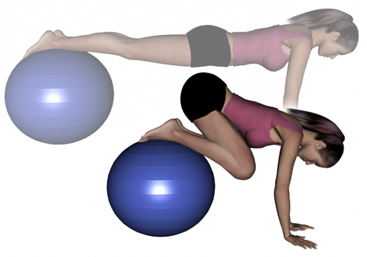
- Start in a push-up position with your feet up on the ball.
- Make sure that you engage your core and raise your hips so your back is flat before you begin.
- Keep your back flat and try not to raise your hips as you draw your knees into your chest.
- Extend both legs back out to the starting position and repeat.
4. Quadruped Bird Dog + Single-Arm Row
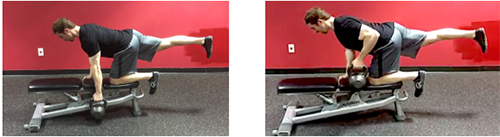
- Get on your hands and knees on a bench.
- Grab a dumbbell with one hand, and lift and extend the leg of the same side behind you so that it is parallel to the floor.
- Keeping your core braced, row the dumbbell up toward your ribcage.
- Do not allow your back to hyperextend or body to twist.
- Pause, then slowly lower the dumbbell toward the bench.
- Repeat all reps, then switch sides.
Why a Calorie is NOT a Calorie
Myth: Calories are the most important part of the diet
It is true that all “calories” have the same amount of energy.
1 calorie (Kcal) = 4184 Joules of energy
When it comes to your body, things are NOT THAT SIMPLE!

- Refined carbohydrates are not good for you
- This includes added sugars like sucrose and high fructose corn syrup
- Refined carbohydrates tend to be low in fiber and they get digested and absorbed quickly
- This leads to rapid spikes in blood sugar
- Hence, they have a high glycemic index (GI)
When we eat a food that spikes blood sugar fast, this leads to a crash in blood sugar a few hours later and then we get cravings for another snack (probably high in carbs L)
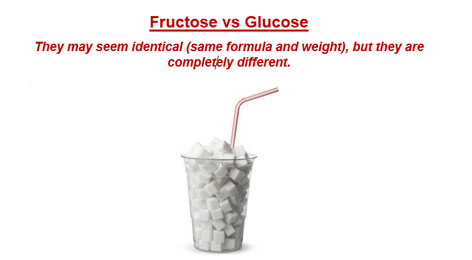
- The two main simple sugars in the diet are glucose and fructose
- Glucose can be metabolized by all of the body’s tissues
- Fructose can only be metabolized by the liver
Ghrelin is the “hunger hormone.”
- It goes up when we are hungry and down when we are satiated
- Fructose leads to higher ghrelin levels (more hunger) than glucose
- Fructose does not stimulate the satiety centers in the brain
A high consumption of fructose can cause:
- insulin resistance
- abdominal fat gain
- increased triglycerides
Note: Fruits also have fructose but in addition, they have fiber and water which can mitigate the negative effects of the fructose.

- Low-carb diets lead to more weight loss, often 3x as much
- People start eating less calories without trying
- Even when calories are matched between groups, the low-carb groups lose more weight
- Low-carb diets also cause significant water loss and reduce excess bloating
Low-carb diets tend to include more protein than low-fat diets
- Protein uses energy to metabolize and turn into glucose used throughout the body
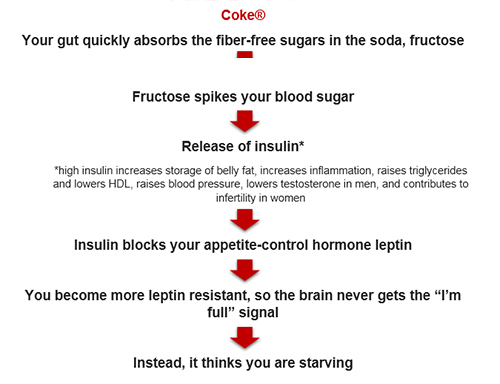
ENTER FRUCTOSE
- It goes directly to your liver, where it starts manufacturing fat
- Triggers more insulin resistance and causes chronically elevated blood insulin levels
- Now, everything you eat gets stored as dangerous belly fat
- You also get a fatty liver, which generates more inflammation
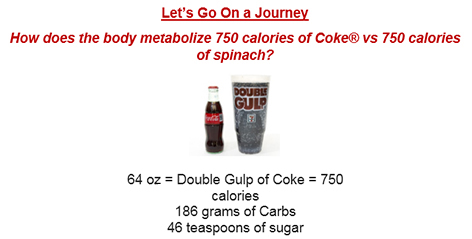
Now you can see just how easily 750 calories of soda can create
biochemical chaos.
In addition, the soda contains no fiber, vitamins, or minerals.
These are “empty” calories devoid of any nutritional value.
But they are “full” of trouble.
Summary:
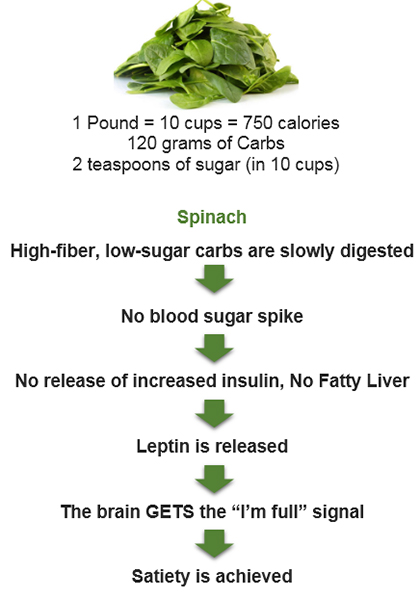
- First, you wouldn’t be able to eat 10 cups of spinach, because it wouldn’t fit in your stomach
- If you could, what would happen?
- They contain so much fiber that very few of the calories would actually get absorbed
- Those that did would get absorbed very slowly
- There would be no blood sugar or insulin spike, no fatty liver, no hormonal chaos
- Your stomach would distend sending signals to your brain that you were full
- You would also get many extra benefits that optimize metabolism, lower cholesterol, reduce inflammation, and boost detoxification
Bottom Line:
- Refined carbohydrates (high glycemic index) lead to faster and bigger spikes in blood sugar, which leads to cravings and increased food intake.
- Even though fructose and glucose have the same chemical formula, fructose has much more negative effects on hormones, appetite and metabolic health
- Low-carb diets consistently lead to more weight loss than low-fat diets, even when calories are matched between groups.
- Different calorie sources can have vastly different effects on hunger, hormones, energy expenditure and the brain regions that control food intake.
- Even though calories are important, counting them or even being consciously aware of them is not at all necessary to lose weight.
- In many cases, simple changes in food selection can lead to the same (or better) results than calorie restriction.
Foot
Foot and ankle injuries include the injuries in the leg below the knee and they are common while playing sports such as football, hockey, skating and in athletes. Treatment for some of these conditions may be orthotics, braces, physical therapy, injections or surgery. Common sports injuries include sprains and strains, ankle
Sports
Sports injuries occur when playing indoor or outdoor sports or while exercising. Sports injuries can result from accidents, inadequate training, improper use of protective devices, or insufficient stretching or warm-up exercises. The most common sports injuries are sprains and strains, fractures, and dislocations.