
All posts by IT Admin
5 Great Total Body Exercises.
Plank
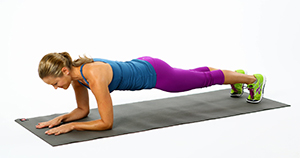
This is a killer move for your core, legs, and upper body. When holding elbow plank, be sure your shoulders are stacked over your elbows and your body is in one straight line.
- Start on the floor, resting on your forearms and knees.
- Step your feet out one at a time, coming into a plank position.
- Contract your abs to prevent your booty from sticking up or sinking. Your spine should be parallel to the floor, with your abs pulling toward the ceiling.
- Hold 30 seconds, and work your way up to one minute as you get stronger.
Push-Up
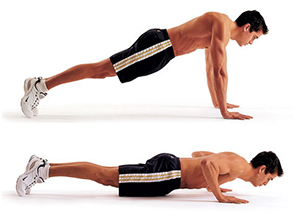
Balance your weight on your toes and palms
- Your hands should be a comfortable distance apart, probably just beyond shoulder-width.
- Your body should form a straight line from your ankles to your head.
- Squeeze your glutes and brace your abdominals, and keep them that way for the duration of the exercise.
- Slowly lower yourself to the floor, pause, and push yourself back up. Repeat a few hundred times.
Side Plank- Hip Abductor
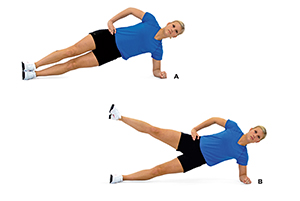
- Lie on one side, legs straight and upper body propped on one forearm, elbow under shoulder.
- Contract your abs and raise your hips until your body is straight from ankles to head.
- Lift your top leg. Pause and lower. Repeat for full set. Turn to other side and repeat.
Squat Jump
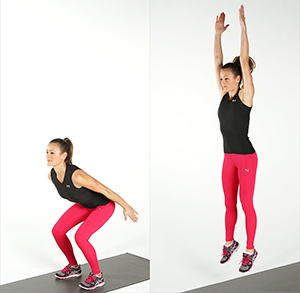
- Stand with your feet shoulder-width apart.
- Start by doing a regular squat, then engage your core and jump up explosively.
- When you land, lower your body back into the squat position to complete one rep. Land as quietly as possible, which requires control.
- Do two to three sets of 10 reps.
The Best of the Best
Burpees
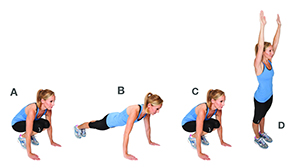
- Squat with your hands on the ground in front of you.
- Jump your feet back to plank (or push up) position.
- Jump your feet back under you to the squat position.
- Immediately jump up as high as you can with your hands straight over your head. Repeat.
- Note: if you want to make the move even more difficult, you can perform a push up when you are in the plank position.
Disclaimer:
Please consult with you doctor before engaging in any new rigorous workout programs
Clinical Services
New Treatment for Knee Arthritis
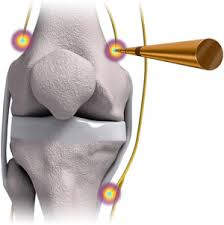
Knee Radio-Frequency Ablation:
- Clinical studies of RFA addressing other sources of pain have demonstrated over 20 months of pain relief and improved physical function
- Is designed to treat complex anatomy of variable nerve courses through the creation of large volume, spherical lesions
- Potentially reduces the amount of time and fluoroscopic exposure through straightforward, familiar placement techniques
Non-Surgical. Minimally-Invasive. Non-Narcotic:
Please call Dr. Singh at 212-746-1500 to schedule a consultation
High Intensity Interval Training.
Millions of Americans don’t engage in that much moderate exercise….
Asked why?
“I don’t have time.”
What is High-Intensity Interval Training (HIIT)?
- Short intense period of exercise, followed by rest
- Instead of continuous moderate-intensity exercise for 20-30 minutes, as is typical for walkers, joggers and cyclists, HIIT involves 30 to 60 seconds of high-intensity exercise near peak heart rate, followed by a period of recovery.
Better than standard “cardio”?
High-intensity exercise may be better than regular aerobic activities for many patients with conditions like heart disease, diabetes, lung disease, joint problems and other musculoskeletal issues.
- More demanding, but more efficient form of exercise
- Now being studied as a treatment that is sometimes as effective as medication for many people with chronic health problems
- Interval training is more effective at enhancing the patients’ physical fitness and reducing body fat relative to lean muscle tissue
How can you implement HIIT?
- Various activities can be adapted to interval training, including cycling, swimming, walking and jogging, especially on a machine like a stationary bike or treadmill.
- Take the stairs everyday
- Rapidly pedaling a stationary bike
- Run uphill on a treadmill
Is HIIT for everyone?
- Lower blood glucose level in patients with diabetes
- Safe and tolerated by patients with coronary artery disease and heart failure
- Patients with chronic obstructive pulmonary disease can do HIIT for periods with less shortness of breath
- Stroke
- Parkinson’s disease
Benefits
- Efficient
- Burn More Fat
- Healthier Heart
- Lose Weight, not Muscle
- Increase Metabolism
Bottom Line
- If you have time for 30 minute, endurance exercise, keep it up!
- Interval training has been an integral part of training programs for many years
- The incorporation of interval training into a general conditioning program will optimize the development of cardiorespiratory fitness as well as numerous other health benefits
Give HIIT a try!

Disclaimer:
Please consult with you doctor before engaging in any new rigorous workout programs
Is Wine THAT good for you?

Alcohol and in particular, red wine, has long been thought of as heart healthy. Red wine contain antioxidants, known as resveratrol, which may help prevent heart disease by increasing levels of high-density lipoprotein (HDL) cholesterol (the “good” cholesterol).
Read More
Benefits of a Low-Carb Diet – Weill Cornell Rehab Update

- The studies consistently show that when people cut carbs and eat more protein and fat, they end up eating much fewer calories.
- As a result, their appetite tends to go down and they often end up eating less without trying.
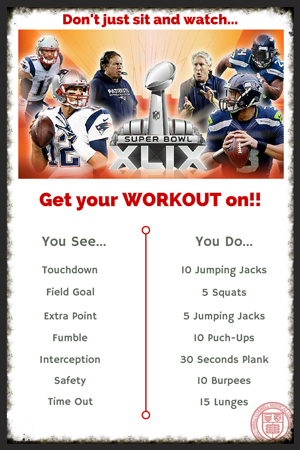
Cornell Sports and Spine – Beat the Super Bowl Bulge
Chronic knee osteoarthritis (OA) is one of the most common diseases of advanced age. With up to 20 million adults in the US suffering from OA of the knee¹, close to 700,000 cases progress to total knee joint replacement.
Read More
Cornell Rehab Medicine- Welcome to 2015!
- Flexion: a curling forward of the spine
- Extension: an arching backward of the spine
- Rotation: a twisting motion of the spine around its axis
- Lateral flexion: a side-bending of the spine
Cornell Sports and Spine – Winter 2014 Updates
- Published in the PMR-Journal- ” Short-Term Efficacy of Sacroiliac Joint Corticosteroid Injection Based on Arthrographic Contrast Patterns.”
- Along with his Chief Resident, a study is completed entitled “The Effectiveness of Topical Diclofenac for Greater Trochanteric Bursitis.” This data will be presented in San Diego, CA at the AAPMR conference.
Weill Cornell Sports and Spine Updates.
Dr. Singh was recently named Director of Interventional Spine at Weill Cornell Medical College

Honored as Super Doctors-New York Rising Star 2013 and 2014
Dr. Singh has been named a Super Doctors 2014 New York Rising Star which represents the top New York doctors in more than 30 specialties that have been fully licensed for 10 years or less.

Traveling to Seoul, Korea (June 2014)
Dr. Singh is invited to the The International Society for the Study of the Lumbar Spine to present his findings on epidural steroid injections used for lumbar disc herniations. Click here for details about the conference
Now Offering Platelet Rich Plasma
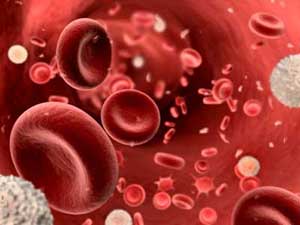
Platelet Rich Plasma (PRP) therapy is a relatively new treatment designed to aid in the healing and regeneration of soft tissues such as tendons and ligaments.
PRP therapy is the solution to this problem. In PRP treatment the patient’s own blood is taken with a simple blood draw. Using a special centrifuge machine this blood is spun down to separate out and concentrate the platelets and growth factors that are essential for tissue healing. This small amount of fluid with concentrated platelets and growth factors is called platelet rich plasma (PRP).
PRP therapy can be used with great success for the following conditions:
Acute and chronic tendon injuries (tendonitis, tendinosis, tendinopathy, tendon tears)
| Foot and ankle: | Plantar fasciitis Achilles tendonitis and partial tears |
| Knee: | Knee Arthritis Patellar tendonitis and tears Quadriceps tendonitis and tears |
| Thigh: | Hip Labral Tears Hip Arthritis Hamstring strains |
| Elbow: | Medial epicondylitis (golfer’s elbow) Lateral epicondylitis (tennis elbow) |
| Shoulder: | Rotator cuff tendonitis and partial tears |
Please call Dr. Singh at 212-746-1500 to schedule a consultation
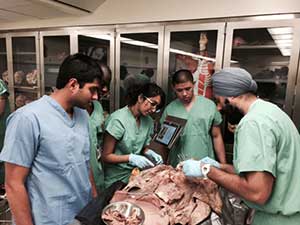
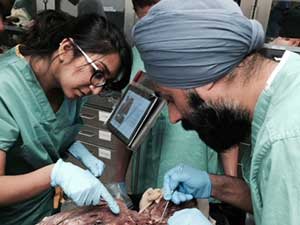
Gross Anatomy Instructor
Dr. Singh spending time with the 1st year Weill Cornell medical students in the gross anatomy lab.
NEW OFFICE HOURS!!
Monday: 8:00am – 6:00pm
Tuesday: 8:30am – 6:00pm
Wednesday: 8:00am – 12:00pm
Thursday: 8:30am – 6:00pm
Friday: 8:00am – 6:00pm
Saturday and Sunday : Closed
Navigating Your Way to a Better Back- September 11, 2014
The Directors of the Cornell Spine Center will be featured on 9/11/14 at the Mrya Mahon Patient Resource Center for a health seminar on back pain. You can view the invitation
Managing Low Back Pain with Exercise
Dr. Singh was featured in the New York Presbyterian newsletter. He discussed non-invasive treatments for low back pain.